


A formulation revision is sitting in the ELN, the instrument result is in a separate folder, and an AI recommendation helped select the next experiment. During an investigation, someone asks a simple question: what changed, who changed it, when did it change, and why was the decision accepted? If your team can answer only part of that question, the system may be recording activity without preserving defensible scientific evidence.

Table of Contents
Why Audit Trails Define Data Integrity in R&D
An audit trail becomes valuable when a reviewer must reconstruct a decision without relying on memory, informal messages, or a scientist's personal explanation. In materials R&D, that reconstruction might involve a formulation revision, a failed test, an instrument recalculation, an approval, or an AI-generated recommendation that influenced the next experiment.
The practical distinction is important. A system log can show that a record was edited. A defensible audit trail should show the sequence of events surrounding the edit, preserve the earlier information, identify the responsible user, and explain the reason for the change. That evidence supports investigations into data integrity, intellectual property, process drift, and regulated manufacturing decisions.
The United States established one of the most influential modern audit-trail frameworks through the FDA's final 21 CFR Part 11 rule, issued in March 1997 and effective August 20, 1997. For covered closed systems, Section 11.10(e) requires secure, computer-generated, time-stamped audit trails that independently record the date and time of operator actions creating, modifying, or deleting electronic records, as described in the FDA's Part 11 scope and application guidance.
The inspection question is reconstructability
Suppose a scientist changes a polymer ratio after reviewing an unexpected viscosity result. The revised formulation may be scientifically justified. The problem begins when the system shows only the final ratio, with no recoverable prior value, no reason code, and no link to the result that prompted the change.
That gap forces an investigator to infer what happened. In an inspection, inference is weaker than contemporaneous evidence. The organization may know the change was legitimate, but it can't demonstrate the decision path with the same confidence as a complete, chronological record.
Practical rule: Treat every critical formulation, test method, result, approval, and AI recommendation as part of a decision history, not as an isolated field in a database.
A reliable audit trail therefore supports more than compliance reporting. It helps scientists distinguish a genuine correction from an undocumented alteration, connect an instrument output to a formulation decision, and establish whether an approval occurred before or after a material entered a downstream workflow. It also protects legitimate scientific work by showing how an invention evolved.
The core requirement is not “log everything.” It is preserve trustworthy evidence for decisions that matter. That means the audit trail must be secure, computer-generated, time-stamped, readable, retained with the associated record, and available for review and copying when required.
The Non-Negotiable Data Elements
A complete event record needs enough detail for an independent reviewer to understand the change without opening a separate investigation into the logging system itself. FDA guidance for electronic records used in regulated research describes an audit trail as a secure, computer-generated, time-stamped record that reconstructs creation, modification, and deletion. It also requires the trail to identify who performed a change, when it occurred, and why, while keeping the original information recoverable rather than overwriting it, as set out in the FDA guidance on computerized systems used in clinical trials.
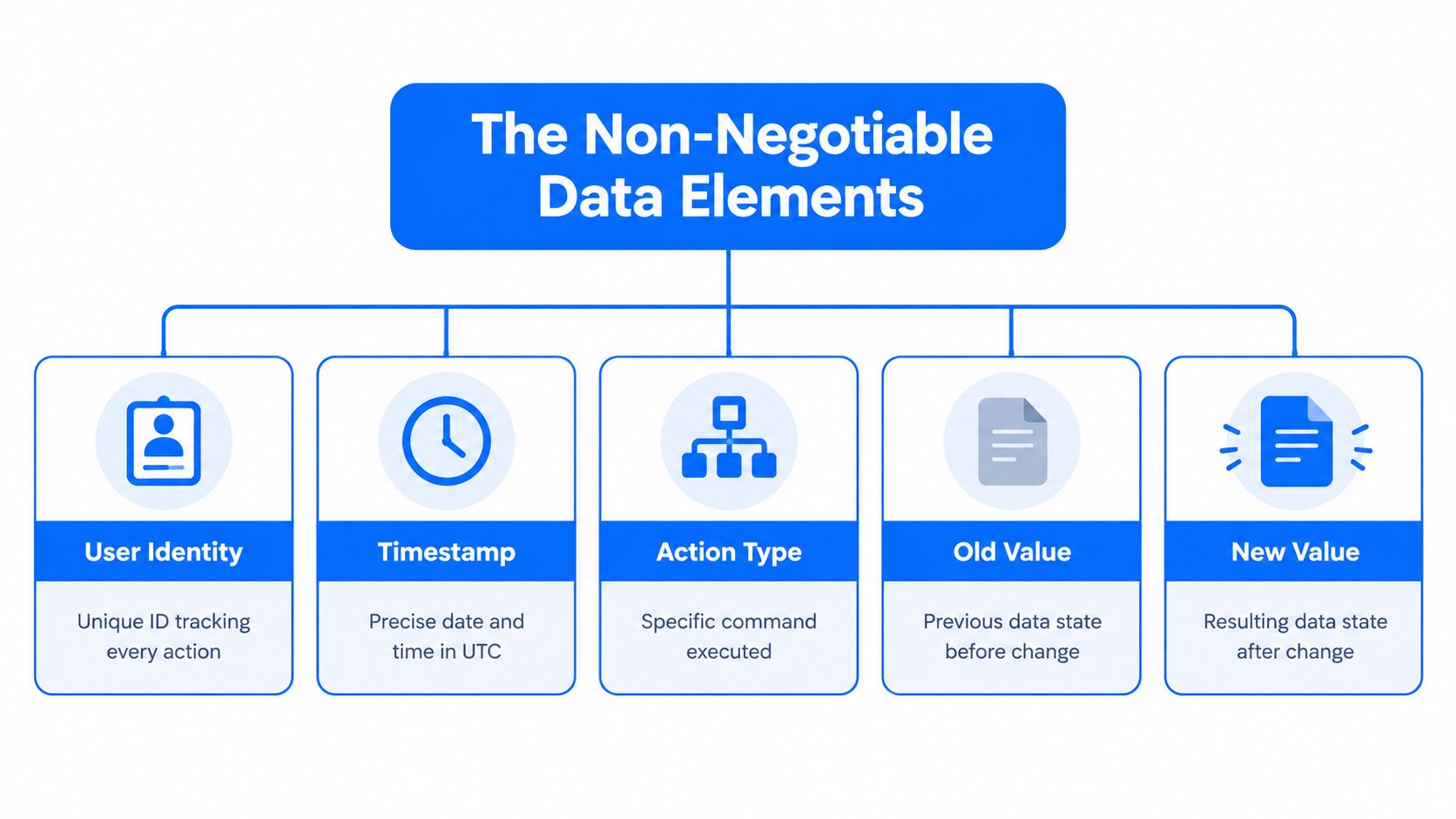
For materials R&D, the following fields form the minimum practical foundation:
- User identity: Bind the event to a unique, authenticated person or controlled system identity. Shared accounts weaken accountability because a reviewer can't establish who performed the action.
- Timestamp: Record when the event occurred using a consistent, trustworthy time source. The timestamp should support chronological reconstruction across the ELN, LIMS, instrument integrations, and approval workflow.
- Action type: Identify what happened, such as creation, revision, deletion, approval, import, export, recalculation, or access attempt. “Record updated” is too vague for a serious investigation.
- Previous value: Preserve the state before the change. A reviewer needs to see whether a formulation input, acceptance criterion, test result, or model parameter was replaced.
- New value: Preserve the resulting state. The comparison between old and new values establishes the precise scope of the change.
- Reason: Require a meaningful explanation when a GMP-relevant or scientifically critical value changes or is deleted. A generic reason such as “correction” may not be enough to explain the underlying event.
- Associated record ID: Link the event to the formulation, experiment, sample, instrument result, approval, or decision record it affects.
Why before and after values matter
A version history that stores only the latest record isn't an audit trail. It may help a scientist work with current data, but it can't show whether a failed experiment was corrected, deleted, recalculated, or replaced with a new result.
The distinction becomes sharper when instrument data enters the workflow. If an imported result changes after recalculation, the audit history should connect the import, the recalculation, the user or service responsible, and the resulting value. Without that relationship, an investigator may see conflicting data without knowing which value was available when the formulation decision was made.
The event must resist ordinary alteration
Users who create or modify experimental records shouldn't be able to rewrite the history of those actions through ordinary permissions. Validation should challenge whether an ordinary user can alter or delete audit entries, whether privileged administrators are separately controlled, and whether exported records remain readable outside the application.
The audit record also needs to remain available for at least as long as the associated electronic record. FDA guidance states that audit trails should preserve prior information, remain available for agency review and copying, and be retained for at least the same period as the related record.
For a practical design test, ask whether an independent reviewer could reconstruct one formulation change using only the exported event history. If the answer depends on undocumented database joins, administrator intervention, or the memory of the original scientist, the trail isn't yet doing its evidentiary job.
Navigating Key Regulatory Standards
Materials organizations often work across pharmaceutical, chemical, medical, and manufacturing environments, so a single compliance label rarely tells the whole story. The useful approach is to compare the operating principles behind the major frameworks and then map those principles to each system and process.
FDA 21 CFR Part 11
Part 11 establishes criteria under which electronic records and electronic signatures can be accepted as equivalent to paper records and handwritten signatures. For covered closed systems, Section 11.10(e) requires secure, computer-generated, time-stamped audit trails that independently record operator actions creating, modifying, or deleting electronic records.
The FDA's 2003 guidance introduced enforcement discretion for some Part 11 controls, including certain validation, audit-trail, record-retention, and record-copying provisions. That discretion didn't remove underlying predicate-rule obligations. For R&D teams, the operational lesson is straightforward: a decision not to enable or review a control still needs a documented, risk-based justification where the associated data supports regulated manufacturing or quality decisions.
EU GMP Annex 11
The revised EU GMP Annex 11 was issued by the European Commission in January 2011 and became effective in June 2011. It applies to computerized systems used in GMP-regulated activities and uses a risk-based approach to determine whether systems should generate audit trails for GMP-relevant changes and deletions, as described in the European Commission's GMP Annex 11 document.
Annex 11 adds practical expectations around reviewability. GMP-relevant changes and deletions should include a documented reason. Audit trails should be available, convertible into a generally intelligible form, and regularly reviewed. Electronic data also needs protection against loss or damage through measures such as duplication, backup, or transfer to another storage system.
| Operating principle | FDA Part 11 | EU GMP Annex 11 |
|---|---|---|
| Record integrity | Secure, computer-generated, time-stamped history for covered systems | Protected, reviewable electronic data throughout its lifecycle |
| Change context | Record operator actions that create, modify, or delete records | Document reasons for GMP-relevant changes and deletions |
| Review | Preserve records and make them available for inspection and copying | Make audit trails intelligible and subject to regular review |
| System approach | Controls support electronic records and signatures | Controls form part of computerized-system lifecycle and risk management |
The convergence matters more than the terminology. Both frameworks point toward attributable, secure, understandable, retained, and reviewable records. A global materials company should therefore build one evidence model for critical R&D events, then apply jurisdiction-specific procedures where the regulatory scope differs.
Teams working with specialized regulated materials should also separate scientific system controls from product-specific legal requirements. For example, a researcher comparing market restrictions may consult a focused resource on Australian peptide rules, while the laboratory's own audit-trail design still needs to establish who changed the record, what changed, and how the decision was reviewed.
Moving Beyond the Feature Checklist
A platform can advertise audit logging and still leave an investigation team without a usable audit trail. The missing component is usually not another event type. It's an operating model that defines which events matter, who reviews them, when the review occurs, and how the review is evidenced.
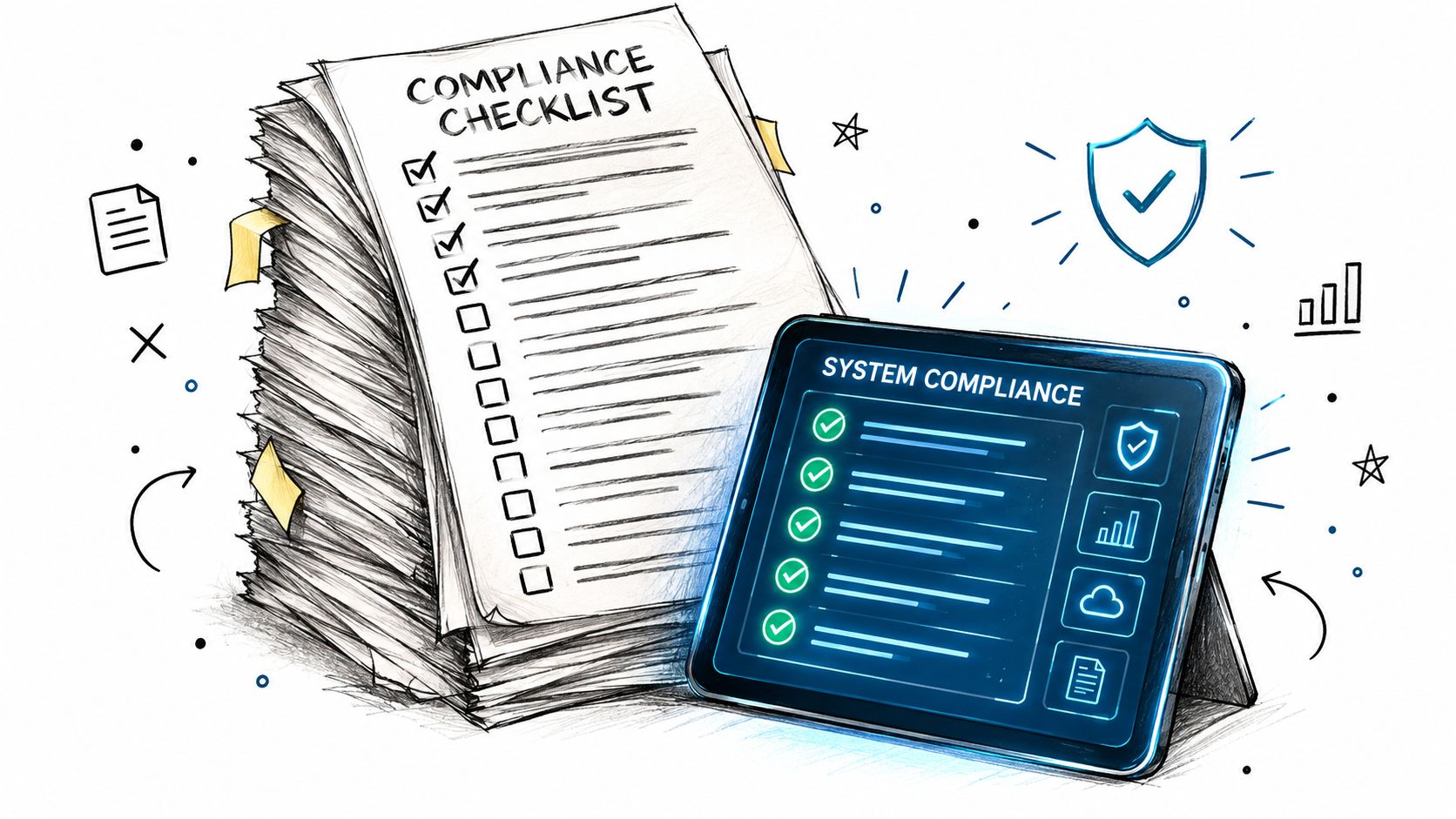
FDA data integrity guidance emphasizes completeness, consistency, and accuracy, and the guidance on audit trails treats review as part of record review rather than as a passive technical output, as reflected in the FDA data integrity guidance for industry. A log that exists but isn't reviewed at an appropriate frequency may not help the organization detect or explain a meaningful change.
Start with risk, not event volume
Capturing every low-value interface event can create a large dataset that obscures the changes an investigator needs to see. Excessive noise also encourages reviewers to approve routine batches mechanically, weakening the review process through alert fatigue.
Prioritize events that can alter scientific conclusions or regulated decisions:
- Critical formulation inputs: Changes to raw-material identity, concentration, ratio, processing condition, or acceptance criterion deserve focused review.
- Analytical results: Recalculations, overwritten results, failed runs, imported values, and changes to test methods should remain connected to the underlying experiment.
- Approvals and dispositions: The trail should show the approver, timing, decision, and any subsequent reversal or modification.
- AI-influenced recommendations: Record when an algorithmic recommendation was accepted, rejected, modified, or used to select the next experiment.
- Administrative interventions: Privilege changes, configuration edits, data exports, and recovery actions can affect the reliability of the scientific record.
Define the review before deployment
For each event class, assign an accountable reviewer and define the evidence that closes the review. That evidence might be a documented approval, an investigation reference, a rationale for accepting a known exception, or a confirmation that no critical event occurred during the review period.
A useful review record answers four questions:
- What population was reviewed? Identify the formulation, study, instrument, workflow, or time range.
- Which events were considered critical? State the risk criteria rather than relying on reviewer intuition.
- What did the reviewer conclude? Record whether the history supports the scientific decision.
- What happened to exceptions? Link unusual events to an investigation, correction, or approved rationale.
The right question isn't “Does the system have an audit trail?” It's “Can an independent reviewer distinguish meaningful scientific changes from routine system noise and prove that the distinction was justified?”
A mature program tests whether the trail can reproduce the decision, not merely whether it can display a log. That test should include a formulation change, a deleted record, an instrument recalculation, an approval reversal, and an administrative intervention. If reviewers can't follow the chronology without technical translation, the organization has a logging feature but not an effective review system.
Handling AI-Generated Data and Decisions
AI-assisted experimentation creates a gap that traditional user-edit logging doesn't close. A model may recommend a formulation, rank candidate materials, identify a causal driver, or propose the next experiment without directly overwriting a regulated record. The important event is therefore not only the later human edit. It is the chain of evidence connecting model input, generated output, human judgment, and experimental outcome.
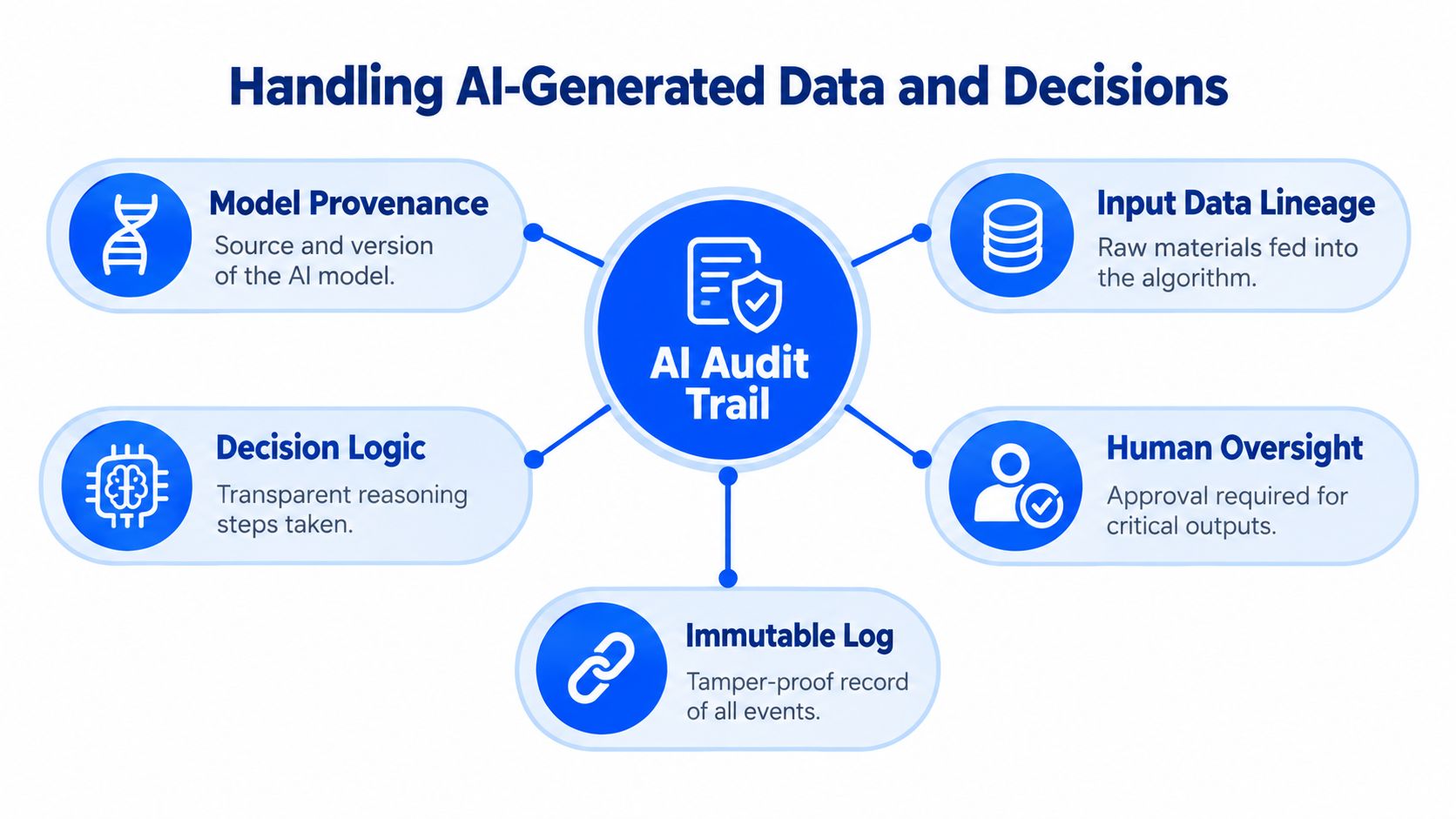
Emerging guidance for AI in regulated laboratories identifies additional evidence needs, including model version, input provenance, reviewer identity, monitoring for model drift, and tamper-evident records of AI outputs, as summarized in the discussion of AI audit trails for regulated laboratory environments.
Capture the decision context
For an AI-influenced materials decision, the event record should preserve:
- Source data and provenance: Identify the datasets, experiments, material records, and feature transformations used by the model.
- Model identity and configuration: Record the model and configuration version, not just the application name.
- Output and uncertainty context: Preserve the prediction, recommendation, confidence score where applicable, and the timestamp of generation.
- Human disposition: Record who reviewed the output, whether it was accepted, rejected, or modified, and why.
- Resulting action: Link the disposition to the formulation revision, selected experiment, approval, or downstream decision.
- Later outcome: Where the workflow permits, connect the recommendation to the observed experimental result and any subsequent interpretation.
A confidence score doesn't explain why a scientist accepted a recommendation. Nor does an explanation generated after the event prove that the model used complete, authorized, and unchanged inputs. Explainability and auditability are related but different controls. Explainability helps a scientist understand a prediction. Auditability establishes what data and model configuration produced it, who reviewed it, and what action followed.
Control the provenance chain
Reproducibility requires more than storing the software version. The same model can produce different recommendations when training data, preprocessing, reference libraries, or configuration change. A defensible trail must therefore bind the output to the actual inputs and model state used at the time.
The human decision deserves equal attention. If a scientist rejects a high-ranked formulation because it conflicts with process knowledge, that rationale may be scientifically important even though no database value was overwritten. If the scientist follows the recommendation, the trail should show the resulting experiment and later outcome. These records turn AI from an opaque suggestion engine into a traceable participant in the workflow.
AI control principle: Preserve the recommendation, the evidence behind it, the human disposition, and the experiment it influenced.
Access segmentation also matters. AI logs may expose valuable formulations, datasets, or proprietary model behavior. Broad visibility can undermine intellectual-property protection, while excessive restriction can prevent effective review. Design the audit trail with role-based access, controlled exports, and retention rules that protect both evidence and confidentiality.
Implementation and Validation Guide
Implementation starts with a map of decisions, not a purchase order. List the records that influence formulation release, method approval, material selection, scale-up, quality decisions, or regulated manufacturing. Then identify where each record is created, modified, approved, imported, analyzed, and archived.
Use that map to assess every ELN, LIMS, instrument connection, spreadsheet workflow, AI service, and SaaS platform involved in the process.
Build the control set
- Define critical events: Include creation, revision, deletion, approval, import, recalculation, access, export, and administrative changes where they affect data integrity.
- Bind identity: Require individual user attribution and separately control service accounts, integrations, and privileged administrators.
- Preserve history: Store old and new values, reason codes, record identifiers, and chronological timestamps without allowing ordinary users to rewrite the trail.
- Protect availability: Test backup, duplication, restoration, readable export, and retention for at least the same period as the associated electronic record.
- Control access: Limit audit-history visibility and administrative privileges according to role and legitimate need, while preserving independent review capability.
- Define review procedures: Assign event owners, review frequencies, escalation thresholds, and evidence requirements before go-live.
- Validate failure paths: Challenge timestamp accuracy, identity binding, deletion handling, export readability, privileged-admin access, backup recovery, and AI model-change recording.
- Test investigations: Give an independent reviewer a formulation change and ask them to reconstruct the decision using the exported trail alone.
The validation protocol should test normal and adverse scenarios. Create a controlled formulation revision, reject an AI recommendation, modify an instrument result through an approved process, attempt an unauthorized audit-record change, and restore records from backup. The expected result isn't merely that the application remains available. It's that the evidence remains complete, attributable, intelligible, and linked to the affected scientific decision.
Retention should be documented in a system-to-record mapping. The organization should know which record controls apply, who owns the retention decision, how legal holds are handled, and how readable copies will be produced for inspection. Review the configuration periodically because integrations, model versions, workflows, and user roles change over time.
For teams evaluating a materials R&D platform, Polymerize records R&D events such as record creation, revisions, approvals, attachments, and access with user identity and timestamps, while connecting AI recommendations to formulation decisions and experiment history. That capability should still be assessed through your own risk analysis, validation protocol, access model, and inspection-readiness tests.
Polymerize can help materials R&D teams unify experimental records, formulation revisions, approvals, and AI-assisted decisions in a traceable workflow. Visit Polymerize to evaluate how its secure, role-based platform can support defensible audit trails from experiment planning through validated material development.
Put your R&D data to work
See how materials teams use Polymerize to plan fewer experiments and reach target properties faster.