

The model worked in the demo. Six weeks later it recommends a formulation that any technician on the floor could tell you is wrong, and nobody can explain why.
So someone opens the project folder. Forty-two spreadsheets, three naming conventions, a file called final_v3_use_this_one.xlsx, and a set of electron microscope images that only one person knows how to read. The experiments were recorded. The data was never built.
That gap between recorded and buildable is where most materials AI programs stall. Closing it is unglamorous, mostly clerical work, and it decides whether a model earns trust or erodes it.
Table of Contents
- What AI Ready Data Means for Materials R&D
- Why Unprepared Data Stalls AI Projects
- Versions Lineage and Reproducible Runs
- Quality Checks That Keep Bad Records Out
- How to Prepare ELN and Spreadsheet Data
- Governance Access and Security Rules
- Pick One Dataset to Make AI Ready First
What AI Ready Data Means for Materials R&D
A shoebox of lab notebooks can hold everything a chemist ever measured about a resin system and still teach a model nothing. The information is in there, in ink, in the order it was written. A recipe can't be cooked from a pile of loose scraps either.
For materials R&D, AI ready data isn't digitized experimental records. It's data structured around explicit measurement definitions, units, metadata, uncertainty and provenance, as a materials-science review published in MDPI's Encyclopedia describes it. The distinction sounds academic until you hit the tensile-strength case. Two labs report 48 MPa. One tested injection-molded Type I bars at 23 °C and 50% relative humidity. The other tested compression-molded plaques after two weeks of conditioning at 80 °C. Identical number, different material behavior, and a model trained on the first will confidently mispredict the second.
Missing test conditions, sample preparation or instrument settings make a nominal property incomparable, and no amount of de-duplication fixes it. The schema has to carry material and formulation identifiers, component concentrations, process history, characterization method, environmental conditions, target-property definitions, units, uncertainty, and links back to source files and protocol versions.
The five attributes that make a record usable
Most of the benefit comes from five fields, and a team can add all of them to a template this week.
| Attribute | What it records | Why models need it |
|---|---|---|
| Identifiers | Material and formulation IDs, component concentrations | Links each result to the exact recipe |
| Units and definitions | Units, measurement definition, property name | Keeps one property comparable across sites |
| Test conditions | Temperature, humidity, instrument settings, sample prep | Separates chemistry effects from test artifacts |
| Uncertainty | Replicate spread and measurement error | Shows how far a prediction can be trusted |
| Provenance | Source file, protocol version, author | Traces every value back to its origin |
A failed experiment is still data. The batch that gelled in the reactor and the coupon that delaminated at 60 °C tell a model where the boundaries are, and deleting them because the result was disappointing removes exactly the negative examples that make next-experiment selection useful.
The test to run today: hand the record to a colleague who never worked on the project. Could they reproduce the result, and would they know which conditions it applies to?
Asset-heavy plants hit the same wall with sensor history, and the predictive maintenance machine learning deployment guide from Forge Reliability shows how that history has to be conditioned, aligned and versioned before a model can act on it. The discipline transfers directly: a vibration reading without a timestamp and a sensor serial is as unusable as a tensile value without a test standard.
Why Unprepared Data Stalls AI Projects
A materials team can have an AI tool and still struggle to put it to work. One model plateaus just above the mean. A folder of micrographs remains unscored because manual review takes too long. Meanwhile, part performance follows a morphology nobody recorded, so the model learns a supplier's lot number instead of the chemistry.
88% of organizations regularly use AI in at least one business function, up from 78% the year before, according to McKinsey's 2025 State of AI survey. Yet only about one-third of respondents say their organizations are scaling AI across the enterprise. Scale matters: nearly half of respondents from companies with more than $5 billion in annual revenue reported reaching the scaling phase, compared with 29% at companies below $100 million.
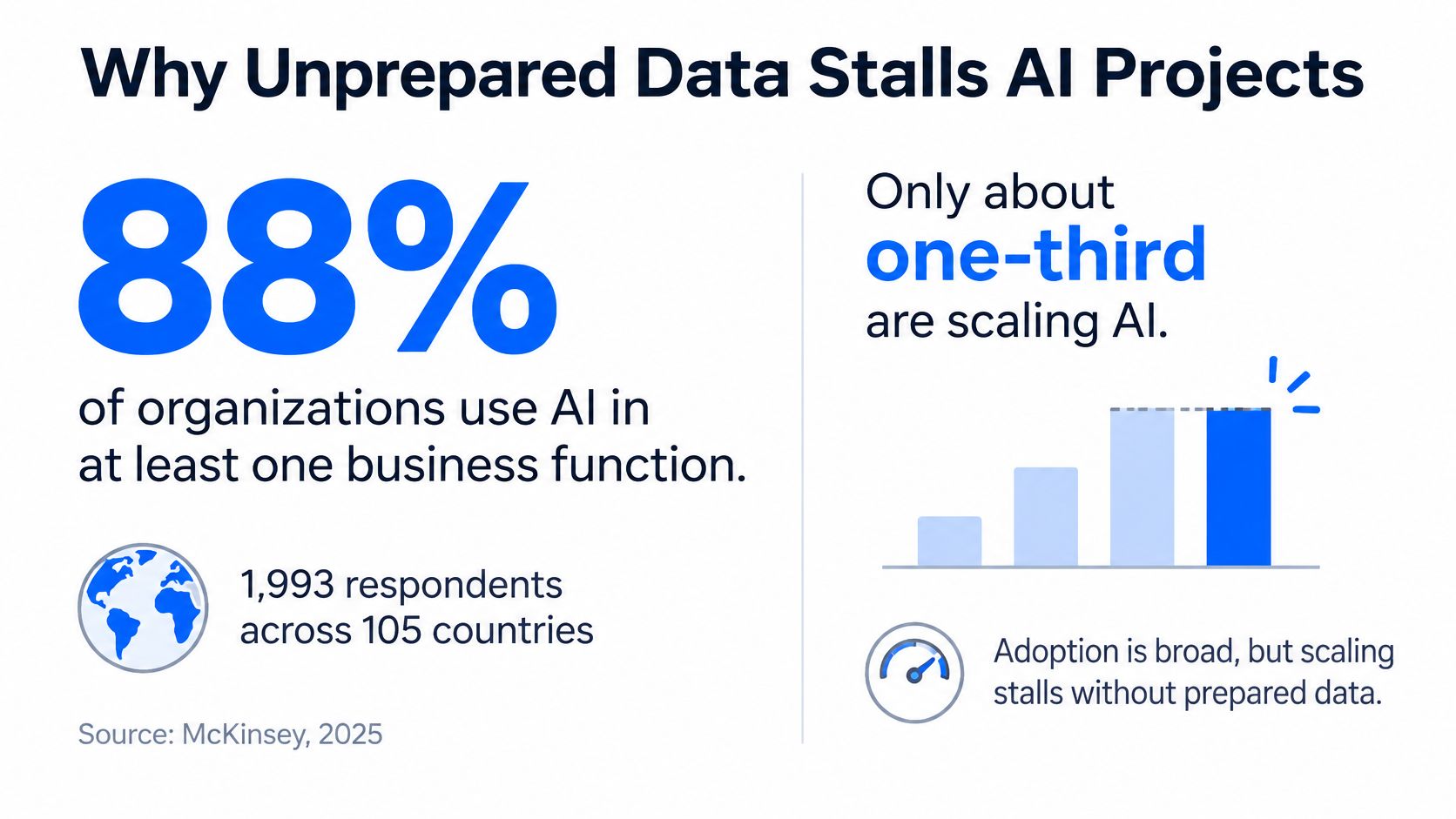
The gap is not a matter of cleaning spreadsheets. A record may have consistent units and still be scientifically inadmissible: the raw instrument file is missing, the test method is unclear, or nobody is accountable for approving the result. In that case, a model can process the data but cannot establish what the measurement represents.
Three questions that expose the gap
- Can you compare this year's formulations with last year's without asking someone to interpret the records? If the comparison depends on memory, the definitions are not shared.
- Can you identify the conditions behind a property value? Otherwise, the model may confuse a chemistry effect with a change in test setup.
- Can you reproduce last quarter's model result from the same inputs? If not, the result is difficult to rely on, even if the model performed well once.
These are governance and reliability problems as well as data problems. IBM's Global AI Adoption Index 2022 reported that 74% of organizations had not taken steps to reduce bias, 68% did not track performance variation or model drift, and 61% did not ensure AI decisions could be explained. When teams cannot establish who owns a record or whether it is fit for a particular use, those weaknesses become harder to address.
Data is often spread across systems that were built for different tasks. A polymer lab may store tensile results in one place, images in another, and formulation sheets in a third. Without a shared way to connect them, analysts have to reconcile records before they can ask whether a recipe change affected performance.
The readiness gap also shows up in how organizations assess their data. In 2024, only 29% of technology leaders strongly agreed that their enterprise data met the quality, accessibility and security standards needed to scale generative AI efficiently, according to the IBM Institute for Business Value. Clean records help, but trust depends on more: the measurement must be scientifically admissible, its raw file must be available, and responsibility for the record must be clear.
Versions Lineage and Reproducible Runs
Lineage is the control that makes a prediction defensible six months after the person who ran the model has changed teams. Treat it as engineering, not paperwork.
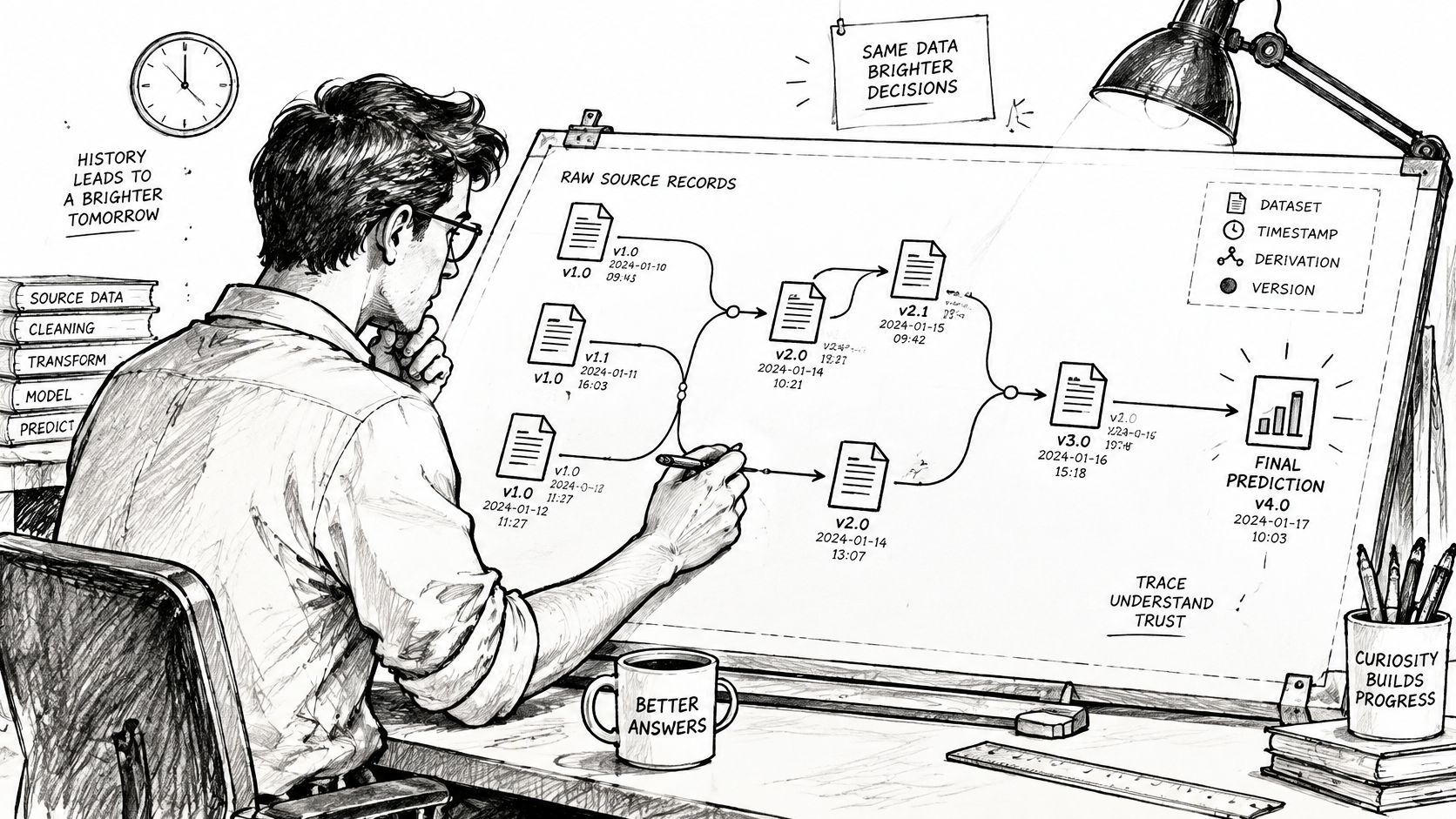
NIST's guidance on data provenance recommends recording where data originated, how it was acquired and transformed, when versions were created, who controlled or modified it, and how it relates to downstream datasets and models. For an industrial materials workflow, that becomes one chain a reader can follow from a recommendation back to an instrument.
- Training-data version, with the snapshot identifier and the date it was frozen.
- Source experiment, keyed to the formulation revision and the protocol version in force that day.
- Laboratory context, meaning the instrument, its calibration state, the site and the operator.
- Preprocessing steps, including every unit conversion, outlier removal, imputation and label correction.
- Model configuration, down to hyperparameters and the uncertainty method used.
That fourth item is where reports break. A unit conversion, an imputation rule or a label correction can change who is in the training population and invalidate a benchmark the team already presented to leadership.
What every run must store: the exact dataset snapshot, the feature-generation code, hyperparameters, random seed, validation split and uncertainty method.
Build the mechanics with immutable identifiers, timestamps, dataset and schema versions, cryptographic hashes on exported artifacts, and an audit log that captures both access and transformation. NIST also points to dataset inventories and provenance records as a way to detect unauthorized modification or data poisoning, which matters more once a formulation database becomes a competitive asset.
The payoff is practical. A scientist can reproduce a number, explain why a formulation was recommended, and see whether the model has wandered outside its historical domain. In polymer and chemical R&D the same chain protects intellectual property during scale-up, quality review and customer audits, because the answer to "how do you know" is a stored record rather than a recollection.
Quality Checks That Keep Bad Records Out
Neatly formatted is not the same as scientifically valid. A row can pass every schema check, validate against its data types, and still be unsafe to learn from because it lacks batch identity, instrument settings, test conditions, or a link between the raw measurement and the derived property.
A 2026 analysis in the Royal Society of Chemistry's Journal of Materials Chemistry A makes the case sharply: processed outputs alone, such as a text representation of a diffraction pattern, aren't enough, and machine-readable instrument-native raw files should be retained alongside them. It recommends checks for publication corrections or retractions, provenance and licensing, statistical anomalies, and physically impossible values.
Those checks cost an afternoon to write and save months downstream.
- Completeness: every mandatory field present for the formulation, or the row is flagged rather than filled with a default.
- Physical plausibility: component fractions that sum past 100%, negative modulus, a glass transition above the decomposition temperature.
- Unit consistency: one store, one unit convention, checked automatically at merge time.
- Replicate spread: a run is flagged when repeats disagree beyond the expected measurement uncertainty.
- Outlier review: statistical outliers go to a reviewer, never to a silent delete.
- External data hygiene: corrections, retractions and licensing checked before any literature dataset enters training.
Where aggressive standardization backfires
Stripping context to make data tidy is a common own goal. Uncertainty, test conditions and raw instrument files look like noise to a normalization script, and removing them produces a dataset that is searchable, model-compatible and scientifically weak. Keep the raw file, keep the flag, keep the failed run, and let the model see the messiness with labels attached.
Answer three questions in writing before anyone signs off. What minimum provenance must accompany each formulation and test result? How are failed or anomalous experiments labeled so they stay usable? Who has authority to declare a record admissible? Those questions get urgent at the point where a model recommends the next experiment or supports a scale-up, because a hidden shift in measurement method can look exactly like a breakthrough in chemistry.
Quarantine rule: a record that fails a plausibility, unit, replicate, retraction or licensing check goes into quarantine with a reason code. It never gets corrected in place.
How to Prepare ELN and Spreadsheet Data
The migration is a sequence, and running it out of order is how teams end up with a second mess layered on the first.
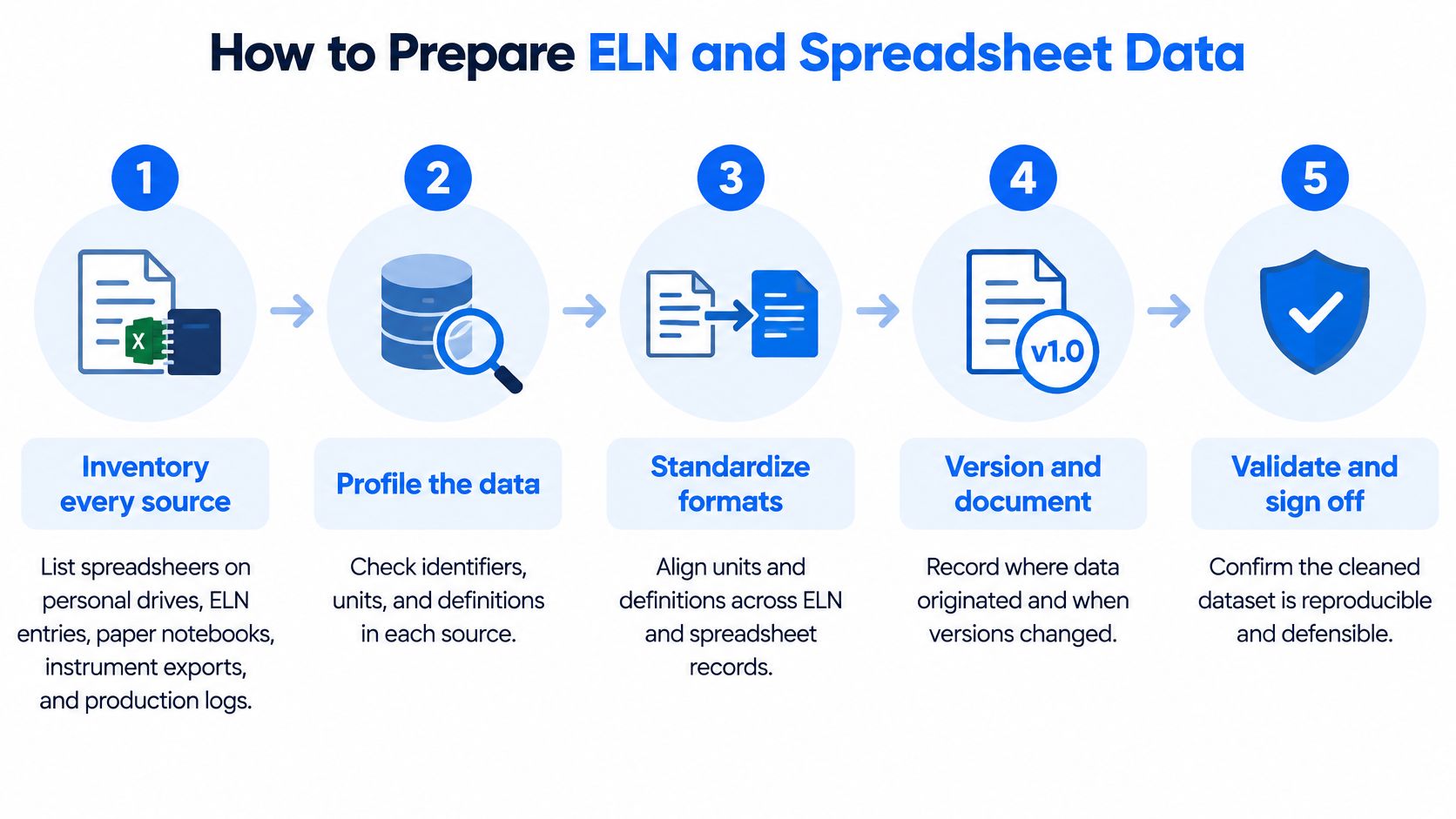
- Inventory every source, including the embarrassing ones. Personal drives, ELN entries, paper notebooks, instrument exports, QC logs and production records. The source people forget is usually the one holding the failed runs.
- Agree one target schema before anyone migrates a row. Use the attribute list from the template work: identifiers, units and definitions, conditions, uncertainty, provenance. Agreement is cheap now and expensive after ten thousand rows exist.
- Map field by field, one source at a time. The classic error is matching column headers without reading the values. A "density" column holds bulk density in one file and true density in another, and the header looks identical in both.
- Convert units once, and store the original beside the converted value. Anyone auditing the transformation can then see both numbers and the conversion factor.
- Migrate in batches and label failures rather than deleting them. A failed run with a reason code is a training example. A deleted run is a hole in the domain.
- Attach provenance to each row. Protocol version, raw instrument file, author and date. This is the field that makes a recommendation explainable later.
- Pilot on one property and one formulation family. Compare migrated values against originals, run the admissibility checks, and quarantine anything that fails instead of editing it in place.
The pilot has succeeded when a scientist can find any historical result and its test conditions in under a minute, without asking the colleague who remembers the project.
| Data source | Typical gap | Preparation fix |
|---|---|---|
| Spreadsheets | Merged cells, units typed into cell text, headers that change between files | One template with separate unit columns and locked headers |
| ELN free text | Results buried in narrative, test conditions missing | Structured fields for each measurement and condition |
| Paper notebooks | Handwritten values, no units or protocol version | Transcribe with a fixed template and link the scanned page |
| Instrument exports | Processed summaries saved, raw files discarded | Keep the native raw file and link it by hash |
| Production or QC logs | Different naming and batch identifiers | Map to shared identifiers and batch keys |
If you'd rather see the preparation logic worked through before starting, this walkthrough covers the same ground end to end.
Governance Access and Security Rules
The readiness paradox is measurable. A 2025 data-readiness study by Enterprise Strategy Group found that 94% of organizations planned to increase data-readiness spending and 74% said data quality has a critical or very high impact on AI success, yet only 48% addressed bias through transparency around model decisions and data sources. The same research reports a separate 2025 survey of 1,700 data leaders across 27 geographies in which only 26% were confident their data could support new AI-enabled revenue streams, and 79% were still early in defining how diverse AI datasets should be scaled and governed.
Centralizing storage doesn't solve that. It can freeze inconsistent semantics and push one site's error to every other site faster.
Who owns which part
Accountability has to be named per role, with evidence, or it defaults to whoever is most annoyed that week.
| Role | Accountable for | Evidence to show |
|---|---|---|
| Scientists | Complete, accurate records at the time of the experiment | Notebook entries linked to raw files |
| Lab managers | Protocol versions and labelling of failed runs | Protocol register with change dates |
| IT and data engineers | Access control, storage and audit logs | Role matrix and exported audit trail |
| Quality team | Release criteria and admissibility sign-off | Signed release record per dataset |
| Legal and compliance | Personal data, IP and cross-border rules | Data processing terms and residency record |
| Model owners | Reproducibility of each model run | Stored snapshot, seed and configuration |
A dataset reaches a model only after five checks pass: completeness, traceability, uncertainty, access rights, and reproducibility. Fail any one and the set stays in staging, no matter how clean it looks.
Security belongs to the same release gate rather than a separate review. That means role-based access, audit logging on every access and transformation, encryption in transit and at rest, and lineage rules that limit who can open a formulation while keeping it usable for the scientists who need it. We're GDPR and CCPA ready for global teams, and we store personal data on secure servers located in Singapore, processing it in other countries where we or our service providers operate, so residency questions get an answer rather than an assumption. Our AI engine needs customer data to predict formulations and experiments and to self-optimize over time, which is precisely why cross-border privacy, retention and IP rules belong in writing before the first model ships.
Pick One Dataset to Make AI Ready First
A polymer formulation family may have hundreds of rows in a spreadsheet and still be a poor first choice for AI. For example, if the rows lack consistent identifiers, test conditions, or reasons for failed runs, a model cannot reliably compare them. Choose a family based on its readiness, not the loudest project sponsor.
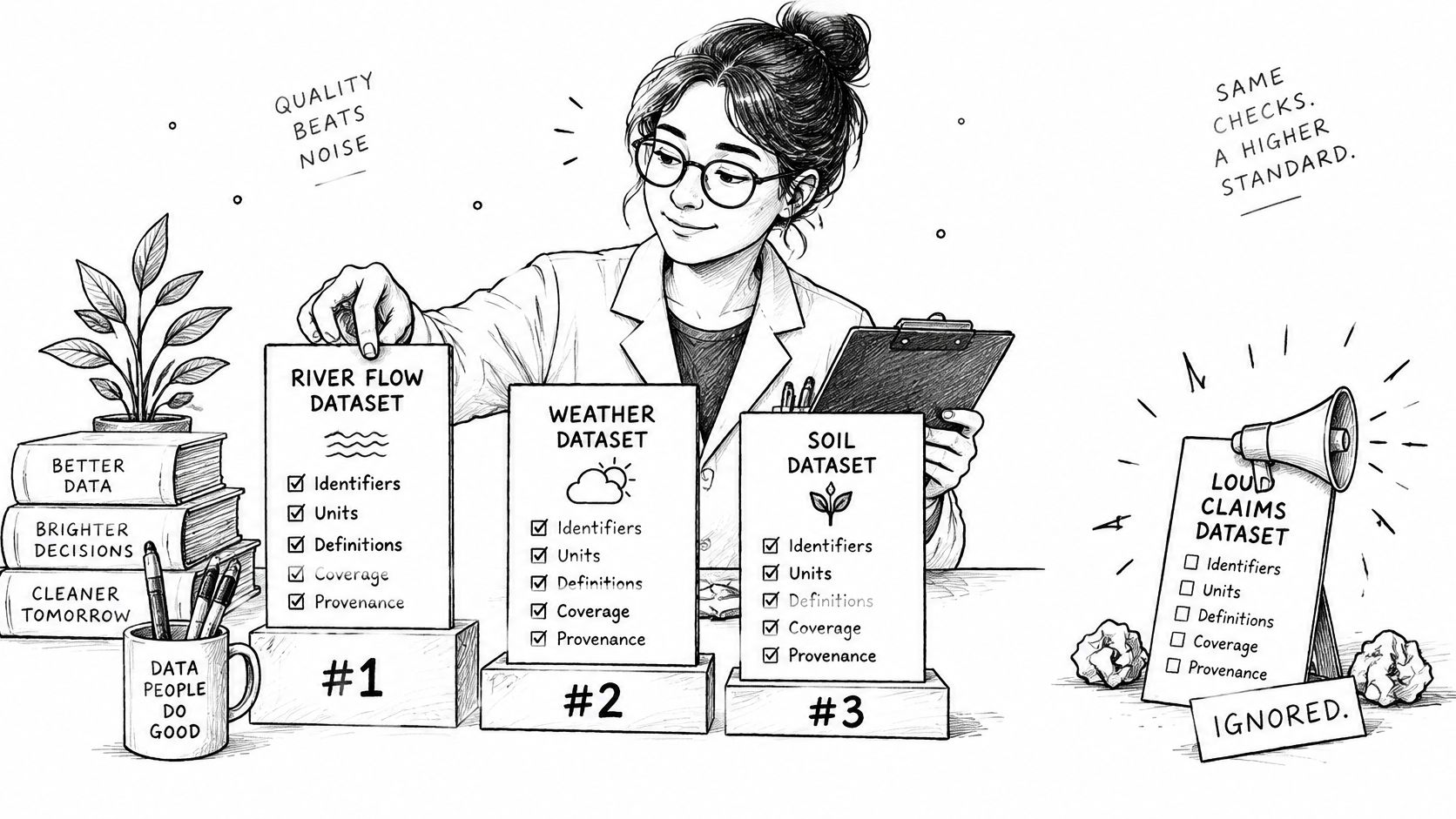
List the three formulation families your lab runs most often. Score each one point for having consistent identifiers, units and definitions, test conditions, uncertainty, and provenance. A family scoring three points with an engaged chemist may be a better first project than one scoring four with no named owner.
Pick a family with a known property target and a few dozen historical experiments. Set a narrow milestone: map one property family to a shared schema, run plausibility and replicate checks, and label failed runs with reason codes. Then assess whether the records are scientifically admissible: are the raw files available, and can someone accountable explain what each result represents? Clean fields alone cannot answer those questions.
Polymerize Connect unifies experiments, formulations, and results in a centralized data backbone accessible to teams across geographies. Polymerize Labs provides explainable predictions with confidence scores and historical precedents. The platform can support the work, but a qualified team member still needs to judge whether the dataset is fit for its intended use.
If the family fails your lab's readiness checks, improve its records before adding another. Once the first dataset is usable, the same scoring approach can help prioritize the next one.
The records you select should connect each result to its test conditions and raw files, with a named owner who can answer questions about how the data was produced. To discuss bringing existing data into Polymerize, contact Polymerize and identify the dataset you want to prepare first.
Put your R&D data to work
See how materials teams use Polymerize to plan fewer experiments and reach target properties faster.